Archive | Pattern Fitting RSS feed for this section

Muslins & Yoke Pockets

It has been a wonderfully on-and-off overcast week here in Austin. I’m pretending it’s raining more than it really is and that I should be having an “inside” day. Which means sewing and lots of pattern-cutting. And blogging. And playing with new tech toys…

My silk shorts pattern is finished and I’ve decided to sew a couple of pairs at the same time. I love a little assembly-line sewing! Until I get them done, I thought I’d share a few things I learned along the way… Today is all about yoke pockets. Over the last year I’ve made several patterns that have had some form of hip yoke pocket. The Lonsdale, the Cambie dress and my shorts all have these pockets. And of course you’d be familiar with them from many trouser and most jeans patterns.

The top pocket is a pretty common Burda pocket in anything with a fly. In Burda patterns, there is often just one piece on the pattern sheet. You’d trace off two separate pieces from that–one for the yoke piece and one for the lining that sews into the front skirt or pant piece. (The little extension is sewn into the center front.) The example on the bottom is a folded yoke pocket that includes lining and pocket in one.

It seemed a bit laborious to sew entire pockets into the muslins of these patterns, but I did–four times! Now I’m guessing I may not be as clever as my readers, but I really didn’t think of a way around this till I started making several test runs of my silk shorts. To cut the pocket and front as one for a muslin, I lined up the yoke pocket piece with the side seams, making sure the grain lines of pocket and short fronts were parallel. The patterns with these pockets often have notches near the hipline and along the waistline where the pocket lines up, which helps lining them up.

When cutting them out, I kept weights on them to make sure they didn’t shift.

Once lined up and taped/weighted onto that front piece, I could draw in the hip shape, remove the pocket and then proceed to cut the front as one whole piece.

What I really want is a flexible shorts block that I can use for multiple styles. So after finally getting the fit I wanted, I ended up making two blocks, one for shorts with pockets and one without. Now I have possibilities for side zips!

If you’ve ever made something with these kind of pockets, you have probably noticed they pull and bulge a bit if there is not enough hip room. Sometimes bulging–or a draped pocket–is intentional, but the pocket and short/skirt front have to be cut that way. Once I did a muslin without pockets I got a much more accurate fit without depending on the ease of the pocket “give”.

Hmmm, now I might be playing around some cool draped pockets like these Philip Lim trousers…

p.s. Sorry all if you wanted or tried to comment on my last post. My offline blog writer played a tricksy on me. All should be working now!

· Comments { 8 }

Pen Pals, Peaches and Lace

Did you ever have a pen pal? (Do you remember those?) When I was a kid I always wanted one. Perhaps I’d get letters from France, or Scotland, or Florida, the envelopes decorated with stickers and hand drawings. I don’t know if this counts (because I was 19 not a kid), but I corresponded with a Polish fella for awhile, the summer after the Berlin Wall fell. His English was new and he wanted to practice. I wanted to know all about a place that had seemed behind a wall for most of my childhood. I was thinking about this today because what seemed so romantic then is so commonplace now. Blogging sort of feels like having a bunch of pen pals, and in instant time!

And I was excited to finally meet one in person last week, the beautiful Lavender of Threadsquare. Sadly, I don’t have photo proof of our meet-up but her dapper man was so kind to snap one. She was wearing an enviable fitted modal knit dress of her own making, and I felt a little bit sorry that all my me-made summer clothes were in the wash. (I am a “wait two weeks to do laundry” sort of lady.) Lavender is just as pretty in person as she is online, and gorgeous in the heart, too. After we parted, I realized how much sewing has been such a lone hobby for me, and that needs to change, STAT. I hope she and her husband find a way to move back to Austin, because it was wonderful to geek out about sewing, art, photography and blogging with someone, even just for a brief hour or so.

Maybe I can talk one of you guys into coming for a weekend to make our own dress forms. Or fit those cigarette pants. Hint, hint, hint. Or, or… bra-fitting?

That’s been the obsession du jour. I finally got cracking on my “Peaches & Cream” set, called thus because peaches are in season now, and I keep buying local ones from the market even though I can’t possibly eat them all. (I’m making cobbler today with the quickly turning leftover fruits.)

Ain’t she purty?

The patterns are Pin-up Girls Classic Bra and Merckwaerdigh Mix30 for the panties. The 2nd pair is my own draft. I used the Merck pattern as a starting point and drew out more of a hipster style with a higher waistline just using stretch lace (no elastic).

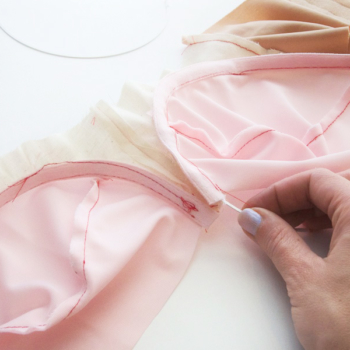
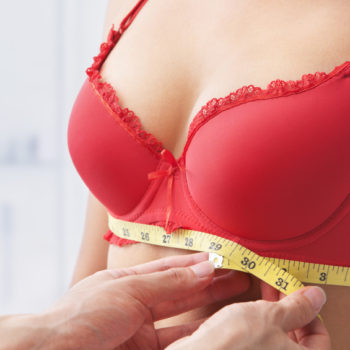
Over the last month, I’ve been experimenting a lot with my bra pattern, drawing out a few new styles and learning a bit about fabric and fit. My first two versions fit me very well, but only in the fabrics included in the Bra-makers Supply kits. The pattern calls for stable, non-stretch tricot for the cups and bridge area, and a firm stretch powernet for the band. Once you venture out into lightweight or stretchier fabrics like stretch lace and jersey–or anything with spandex–you’ll probably discover as I did that the pattern needs a bit of tweaking. My last version of this bra in my Byzantine set, turned out quite large in the cups and a little big in the band.

By pinching out the excess in the cups of my previous bra, I was able to get a good idea of what to remove and adjust. And it fits perfectly! Hopefully, this illustration will help someone else find a starting point for a similar alteration (say, if you’re changing from a more rigid fabric to cotton jersey that won’t be interfaced or padded). This adjustment removes both depth from the lower cup and length from the upper cup:

In my case, I removed almost 1/2″ in depth from the apex of the lower cup, going to zero at the sides. If you are using jersey or lingerie lycra for the band instead of powernet, you may need to shorten the back band a bit, too.

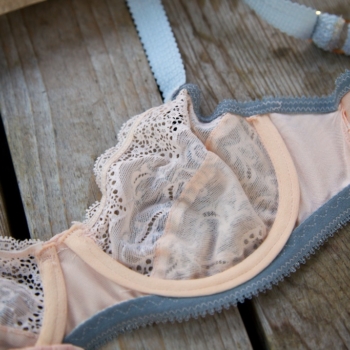
The fabric and notions are all from a Merckwaerdigh kit. If you’ve been stalking Novita’s bras as I have, you might recognize these fabrics from one of her sets. Peach and grey are one of my favorite color combinations, and I just couldn’t resist snapping up the same kit! The Merck kits are very similar to Elingeria’s, including a meter of stretch lace, and enough lingerie lycra (a nylon/spandex jersey) for one bra and two panties.

I like that Merckwerdigh’s kits also include cotton knit fabric for the panty lining, tiny elastic for the neckline on the cups and a small amount of stable sheer tricot to line and stabilize the lace or bridge, which you can see in the photo above. The tricot feels better against the skin than just lace, and adds a bit of modesty. (While Elingeria offers more variety, you’ll have to add those extras on your own if you want them.)

Happy sewing, y’all!

Back to the peach cobbler…

· Comments { 19 }

Fixing a Rise: Scallop Shorts Alteration

Howdy all, hope you’re having a beautiful week! We’ve been having mad storms here the last couple of days, and hallelujah, I’m so happy it’s raining. Our dogs, on the other hand, get nervy with all the thunder and lightning, and last night the youngest one bolted out of our gate, disappearing for SIX hours. Nothing like running around in Texas-sized tree-felling winds, yelling out “JAKEY WAKEY!” all over the neighborhood (Jakob, Jake, Jakey, Lanky Jakey…)! Turns out he found his way to our friend’s house several blocks away to huddle on the porch–smart border collie.

Anyways, a few readers asked for a visual of how I adjusted the front rise of my scallop shorts so I used a little rainy day to put together a pictorial. I know it’s hard to explain those things in words! I dug out my muslin to give you an idea of what was going on. I don’t know what was going on with this pose, my awkwardest attempt to keep the side seams closed while simultaneously keeping my arms out of the picture:

Unfortunately, I adjusted my muslin before I could get pics, but this is what it looked like after doing a minor version of my adjustment–you can see the residual problem and it got even better after I did more adjusting.

Problems:

* Front rise is too long (hence the horizontal folds or droopiness).

* The curve or dip point of the front crotch seam stands too far away from the body. The radiating folds that extend from it feel restricting.

It seemed the folding was due to both excess vertical length AND stress from being too tight around the hips. So here’s what I did:

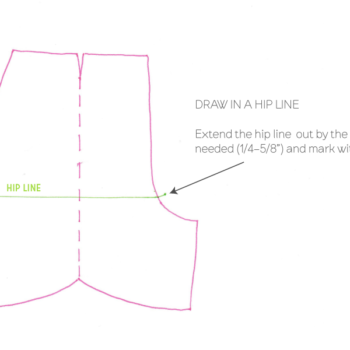
1. Drew in a hip line. There wasn’t one on my pattern, but I marked the spot on the center front of my muslin where the fold was, and used that as the hip line.

2. Then I extended the hipline about 1/2-5/8″ from the original edge and marked a dot. I tested this by re-sewing the curve 1/4″ into the seam allowance on my muslin, then re-drew it further out for the final version.

(If you want to get really precise, you can mark in the seam lines, and measure out from that line, then re-draw the seam allowances.)

3. Then I re-drew the curve to meet that dot. The curve is now shallower, which also makes it shorter. You can also see that the front hip width has now gotten wider as a result. By re-drawing that curve, I gave myself about an inch total more hip room.

4. I still had a bit of excess length in the front so I took out a wedge along the waistline, about 3/8″, starting at center front and tapering to nothing at the side seam.

I’m pretty happy with the way it all turned out! Has anyone else battled this kind of fit issue? I’d love to hear what has worked for you.

I hope that helps!

· Comments { 16 }

Balloons and Cocoons

My first reaction to this coat was a bit melodramatic. Whoa, this coat is a balloon!


I knew what I was getting into, the pattern’s line drawing makes it clear that this is a cocoon-like coat. (I love that Burda calls it a “hinted boule silhouette”.) Within minutes I was pinning it in all over the place to reduce some of its volume. Although I finished this peach version of the shell a week ago, it took a couple of days of stepping back, taking a bunch of pictures, letting it have some quality time on the dressform to change my perception. I’m not going to be walking around with my arms splayed out like I do when I’m examining fit, thereby exaggerating the shape.

Of course, my “muslin” fabric is also exaggerating the shape by the way it floats a bit stiffly. The “suede” was a bit of a mystery buy dug out of Joann’s mega-clearance pile in the home dec section, but it was perfect to try out sewing on a nappy fabric. This stuff is so groovy that I might even transform it into a coat of its own. (Perhaps it’s something like polyester microsuede? It’s a woven with a satin-y reverse.) It has the softest feel, and in one of those peachy coral colors that can never do wrong by me.

An interesting thing about this pattern is the fact that the armholes are quite low, landing almost an inch above the bust dart. I should probably check and see if that is typical for one of Burda’s raglan-sleeved coats. Normally that’d make for some immobilizing sleeves, but there’s a lot of room to move around: the ease right above the bustline is something like 13 inches!

The smallest size on the pattern sheet was a 38 so I graded down to a 36 and I’m glad I did since this style has so much room. (Are you curious how to grade down a multi-sized pattern? I figured it out from this PR tip about grading up a size–I just did the reverse.)

My actual coat fabric is very soft and drapey and so I think the whole shape will relax into gentle folds. I’ve been lusting after Persian lamb fabric since last winter; something about it reminds me of my grandmother’s couches. I’d describe it more as a velvet than a faux fur, with rippled curly pile. (And no, it’s not real lamb fur, although apparently there is a real.)

There are a few little changes I need to do before cutting into my “fur”. The original pattern has an exposed zipper closing up the front. Since I’m replacing the ribbon trim with a leather binding I’ll have to sew the zipper into the binding somehow. That’s this week’s puzzle! The sleeves were shorter than I expected, but now that I’m looking at them in pictures, I might even shorten them more. It helps balance out the proportions and a wrist-length sleeve would probably just look overwhelming. I really don’t want to turn into Blueberry Girl. I’m okay with “boule”. French just makes everything sound better, no?

· Comments { 13 }